
Innovative solutions for security
Discover how VXLAN EVPN transforms modern data center networking through scalable Layer 2 and Layer 3 overlays, BGP EVPN control-plane learning, spine-leaf architecture, distributed anycast gateways, multi-tenancy, and resilient workload connectivity. Exp
VXLAN EVPN Explained: Modern Data Center Architecture
Building Scalable, Secure, and Resilient Enterprise Data Center Networks
Modern enterprise data centers are evolving rapidly to support virtualization, cloud computing, containerized applications, distributed workloads, and business-critical services.
Traditional VLAN-based network designs can become difficult to scale and manage when organizations require large numbers of isolated network segments, flexible workload placement, and connectivity across multiple racks or data center locations.
To address these challenges, modern data center architectures increasingly adopt Virtual Extensible LAN (VXLAN) with Ethernet VPN (EVPN).
Together, VXLAN and BGP EVPN provide a scalable network overlay architecture that supports Layer 2 and Layer 3 connectivity across a routed IP infrastructure.
At Pruthvija Technologies, we focus on modern data center architectures that combine network scalability, high availability, secure segmentation, and operational efficiency.
This article explains VXLAN EVPN fundamentals, architecture components, traffic forwarding, design considerations, and enterprise implementation best practices.
1. What Is VXLAN?
VXLAN stands for Virtual Extensible LAN.
It is a network virtualization technology that encapsulates Layer 2 Ethernet frames inside UDP/IP packets, allowing Ethernet segments to extend across a Layer 3 network.
Traditional IEEE 802.1Q VLAN identifiers provide approximately 4,094 usable VLAN IDs.
VXLAN introduces a 24-bit VXLAN Network Identifier (VNI), offering a theoretical identifier space of approximately 16.7 million values.
Key Benefits of VXLAN
-
Large-scale logical network segmentation
-
Layer 2 connectivity over Layer 3 transport
-
Flexible virtual machine and workload placement
-
Support for multi-tenant environments
-
Reduced dependence on extended physical VLAN domains
-
Integration with routed spine-leaf architectures
-
Support for distributed gateway designs
VXLAN itself provides data-plane encapsulation. It does not independently provide a complete endpoint discovery and control-plane solution.
That is where EVPN becomes important.
2. What Is EVPN?
EVPN stands for Ethernet VPN.
In a modern VXLAN fabric, EVPN commonly uses Multiprotocol BGP to advertise endpoint reachability, MAC addresses, IP addresses, and related routing information.
Instead of relying entirely on data-plane flooding and learning, BGP EVPN enables participating devices to exchange endpoint information through a control plane.
Key EVPN Capabilities
-
MAC address advertisement
-
IP-to-MAC reachability information
-
Endpoint mobility signaling
-
Multi-tenant routing information
-
Support for integrated Layer 2 and Layer 3 services
-
Reduced reliance on flooding for known endpoints
-
Control-plane-assisted convergence
Important distinction:
VXLAN is primarily the data-plane encapsulation technology.
BGP EVPN provides the control-plane information used to establish and maintain overlay reachability.
Together, they form a powerful foundation for modern data center networking.
3. Why Modern Data Centers Use Spine-Leaf Architecture
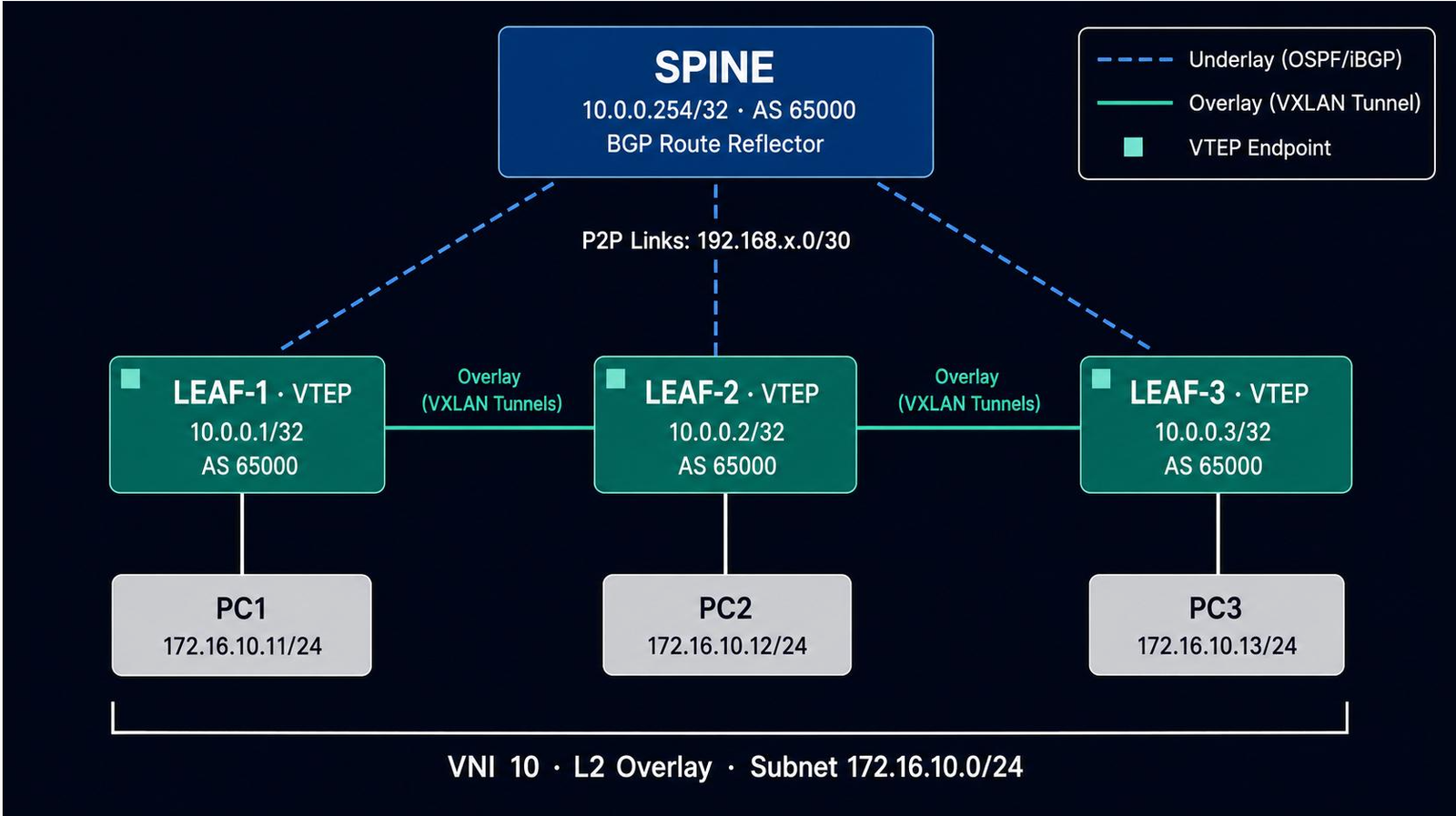
Modern VXLAN EVPN deployments commonly use a spine-leaf topology.
Spine Layer
Spine switches provide high-speed IP transport between leaf switches.
Typical functions include:
-
Layer 3 underlay connectivity
-
ECMP forwarding
-
High-bandwidth fabric transport
-
Dynamic routing
-
Optional BGP EVPN route reflection
Leaf Layer
Leaf switches connect servers, hypervisors, storage systems, firewalls, and external networks.
Leaf switches commonly function as VXLAN Tunnel Endpoints (VTEPs).
Typical responsibilities include:
-
Server and workload connectivity
-
VLAN-to-VNI mapping
-
VXLAN encapsulation and decapsulation
-
Distributed gateway functions
-
Tenant VRF integration
-
BGP EVPN endpoint advertisement
-
Network segmentation
Why Spine-Leaf?
A well-designed spine-leaf fabric provides predictable network paths and supports multiple active equal-cost routes.
Unlike traditional Layer 2 designs that may block redundant links through spanning tree, routed spine-leaf fabrics can use ECMP to forward traffic across multiple available paths.
Best practice: Use a resilient routed underlay with consistent addressing, predictable routing behavior, and sufficient bandwidth capacity.
4. Understanding the Underlay and Overlay Networks
VXLAN EVPN architecture separates the physical transport network from logical tenant connectivity.
Underlay Network
The underlay provides IP connectivity between VTEP addresses and other fabric infrastructure endpoints.
Common underlay routing protocols include:
-
OSPF
-
IS-IS
-
eBGP
Typical underlay design elements include:
-
Point-to-point routed interfaces
-
Loopback addresses
-
ECMP
-
Routing adjacency monitoring
-
MTU planning
-
Fast failure detection where appropriate
The underlay does not need to learn every tenant MAC address.
Its primary responsibility is transporting encapsulated traffic between VTEPs.
Overlay Network
The overlay provides logical tenant connectivity using VXLAN and BGP EVPN.
It commonly includes:
-
Layer 2 VNIs
-
Layer 3 VNIs
-
Tenant VRFs
-
MAC/IP route advertisements
-
Distributed anycast gateways
-
Overlay BGP peering
-
Route targets and route distinguishers
Best practice: Troubleshoot underlay IP reachability before investigating overlay endpoint learning or application connectivity.
5. VXLAN Encapsulation Explained
VXLAN encapsulates an original Ethernet frame inside an outer UDP/IP packet.
The packet structure is:
Outer Ethernet Header → Outer IP Header → UDP Header → VXLAN Header → Original Ethernet Frame
The standard VXLAN UDP destination port is 4789.
VXLAN Tunnel Endpoint
A VTEP is responsible for encapsulating and decapsulating VXLAN traffic.
When a server connected to one leaf communicates with a server behind another leaf:
-
The ingress leaf identifies the destination's overlay reachability.
-
The ingress VTEP encapsulates the original Ethernet frame in VXLAN.
-
The IP underlay forwards the packet toward the remote VTEP.
-
The remote VTEP decapsulates the packet.
-
The destination leaf forwards the original Ethernet frame toward the endpoint.
This process enables logical Layer 2 connectivity across a routed network.
MTU Considerations
VXLAN introduces encapsulation overhead.
The underlay MTU must accommodate the original Ethernet frame plus the additional outer headers.
For a conventional IPv4 VXLAN encapsulation, approximately 50 bytes of additional overhead is a common planning baseline, although actual requirements depend on packet format and features.
Best practice: Validate the complete end-to-end MTU rather than assuming that a standard 1500-byte underlay will accommodate every encapsulated workload packet.
6. Understanding Layer 2 and Layer 3 VNIs
VXLAN uses VNIs to identify logical network segments.
Layer 2 VNI
An L2 VNI identifies a Layer 2 broadcast domain.
For example:
-
VLAN 100 → L2 VNI 10100
-
VLAN 200 → L2 VNI 10200
-
VLAN 300 → L2 VNI 10300
These are illustrative mappings, not mandatory numbering conventions.
Layer 3 VNI
An L3 VNI is associated with a tenant VRF in common symmetric IRB designs.
For example:
-
VRF-CORPORATE → L3 VNI 50001
-
VRF-PRODUCTION → L3 VNI 50002
L3 VNIs enable routed tenant traffic to traverse the VXLAN overlay while maintaining the appropriate routing context.
Important Design Consideration
A VNI is not a substitute for a security policy.
Traffic isolation depends on VRF separation, routing policy, firewall controls, and other configured enforcement mechanisms.
7. Distributed Anycast Gateway
A distributed anycast gateway allows multiple leaf switches to provide a common default gateway IP and corresponding virtual MAC address for a subnet.
For example:
VLAN 100 / VNI 10100
Subnet: 10.10.100.0/24
Default Gateway: 10.10.100.1
The same gateway IP and anycast MAC can be configured on participating leaf switches according to the platform design.
Benefits
-
Local first-hop routing
-
Reduced dependence on a centralized gateway
-
Improved workload mobility support
-
Efficient inter-subnet traffic forwarding
-
Distributed Layer 3 forwarding
A distributed gateway does not eliminate the need for routing policy, route advertisement, or security enforcement.
Best practice: Use consistent anycast gateway configuration and validate ARP, neighbor discovery, and endpoint mobility behavior.
8. Symmetric vs. Asymmetric IRB
Integrated Routing and Bridging (IRB) combines Layer 2 bridging and Layer 3 routing in a VXLAN EVPN fabric.
Two common approaches are asymmetric and symmetric IRB.
Asymmetric IRB
In an asymmetric IRB model, the ingress VTEP routes between subnets and bridges the packet into the destination Layer 2 VNI.
This approach can require broader distribution of tenant Layer 2 information across participating VTEPs.
Symmetric IRB
In a symmetric IRB model, traffic is routed into the tenant's Layer 3 VNI and transported to the remote VTEP, where the destination-side routing and bridging operations are completed.
Symmetric IRB commonly provides a more scalable approach for large multi-subnet environments.
Best Practice
For modern enterprise data center designs, symmetric IRB is frequently preferred, subject to platform support, interoperability, and specific architecture requirements.
9. BGP EVPN Route Types
BGP EVPN uses different route types to advertise information required by the overlay.
| Route Type | Purpose |
|---|---|
| Type 1 | Ethernet Auto-Discovery |
| Type 2 | MAC/IP Advertisement |
| Type 3 | Inclusive Multicast Ethernet Tag |
| Type 4 | Ethernet Segment |
| Type 5 | IP Prefix Advertisement |
Type 2: MAC/IP Advertisement
Type 2 routes advertise endpoint MAC addresses and, when applicable, associated IP information.
They are important for endpoint discovery and mobility.
Type 3: Inclusive Multicast Ethernet Tag
Type 3 routes help establish information used for broadcast, unknown-unicast, and multicast traffic distribution.
Type 5: IP Prefix Advertisement
Type 5 routes advertise IP prefixes through EVPN and are commonly used in routed overlay designs.
Route Types 1 and 4 are particularly relevant to EVPN multihoming designs.
Best practice: Verify route targets, route distinguishers, VNI associations, and the appropriate EVPN route advertisements when troubleshooting connectivity.
10. VXLAN EVPN Multi-Tenancy and Segmentation
Multi-tenancy allows separate organizations, departments, applications, or security domains to share physical infrastructure while maintaining logical separation.
A typical design may include:
Tenant A
-
VRF-A
-
VLAN 100
-
VLAN 200
-
L2 VNIs 10100 and 10200
-
L3 VNI 50001
Tenant B
-
VRF-B
-
VLAN 300
-
VLAN 400
-
L2 VNIs 10300 and 10400
-
L3 VNI 50002
Each tenant maintains its own routing context.
Communication between tenants requires deliberate inter-VRF connectivity or another approved integration mechanism.
For sensitive workloads, additional security enforcement may be required through firewalls, ACLs, or microsegmentation controls.
11. VXLAN EVPN High Availability
High availability is a major design objective in modern data centers.
Common resilience mechanisms include:
-
Redundant spine switches
-
Multiple leaf-to-spine uplinks
-
ECMP
-
Dynamic underlay routing
-
BGP EVPN control-plane redundancy
-
vPC or supported EVPN multihoming designs
-
Redundant server connectivity
-
Distributed gateway functions
-
Device and link failure monitoring
Common Failure Scenarios
Network architects should validate:
-
Spine switch failure
-
Leaf-to-spine link failure
-
BGP EVPN neighbor failure
-
Underlay routing convergence
-
VTEP reachability loss
-
Dual-homed server uplink failure
-
Endpoint mobility
-
Inter-VRF or firewall connectivity
-
External routing failure
-
Application service continuity
Best practice: Validate convergence and application impact during controlled failover testing, rather than relying only on interface and routing status.
12. VXLAN EVPN vs. Traditional VLAN Networking
| Capability | Traditional VLAN-Based Networking | VXLAN EVPN |
|---|---|---|
| Segmentation scale | Approximately 4,094 usable VLAN IDs per VLAN ID space | 24-bit VNI space |
| Layer 2 extension | Primarily physical Layer 2 connectivity | Layer 2 overlay across routed IP |
| Endpoint learning | Primarily data-plane MAC learning | BGP EVPN control-plane-assisted learning |
| Multi-tenancy | VLANs, VRFs, security policies | VNIs, VRFs, EVPN routing policies |
| Active multipath | Depends on design | Commonly uses ECMP underlay |
| Distributed gateway | Possible with suitable platforms | Common architectural feature |
| Automation | Available through external tools and controllers | Available through APIs, controllers, and templates |
| Operational complexity | Depends on network scale | Requires underlay and overlay expertise |
VXLAN EVPN provides important scaling and architectural advantages, but it introduces additional control-plane, encapsulation, and troubleshooting considerations.
13. Common VXLAN EVPN Deployment Challenges
Underlay Connectivity Issues
VTEP loopback addresses may be unreachable due to missing routes, failed routing adjacencies, or interface problems.
BGP EVPN Peering Issues
Incorrect neighbor configuration, address-family activation, or route-reflector design can prevent EVPN route exchange.
Incorrect VNI Mapping
Inconsistent VLAN-to-VNI mappings can cause traffic isolation or forwarding failures.
Route Target Mismatch
Incorrect import and export route targets may prevent the appropriate MAC/IP or IP-prefix routes from being installed.
MTU Mismatch
Insufficient underlay MTU can cause packet drops or application performance problems.
Anycast Gateway Inconsistency
Incorrect gateway IP or MAC configuration may affect ARP behavior and inter-subnet routing.
Firewall and External Routing Integration
Improper route advertisement, security policies, or asymmetric traffic paths may disrupt application connectivity.
Best practice: Use a structured troubleshooting sequence: physical interfaces → underlay routing → VTEP reachability → BGP EVPN → VNI and VRF mappings → endpoint learning → security policies → application validation.
14. Recommended Implementation Methodology
At Pruthvija Technologies, a structured VXLAN EVPN deployment methodology can include the following phases.
Phase 1 — Assessment
Review existing data center infrastructure, server connectivity, network dependencies, security requirements, and growth objectives.
Phase 2 — Architecture Design
Develop the spine-leaf topology, addressing plan, routing design, VNI assignments, VRF structure, and gateway architecture.
Phase 3 — Underlay Deployment
Configure routed fabric links, loopbacks, routing adjacencies, ECMP, and MTU requirements.
Phase 4 — Overlay Deployment
Configure VTEPs, BGP EVPN, VNIs, VRFs, route targets, and distributed gateways.
Phase 5 — Security and External Integration
Integrate firewalls, WAN connectivity, application segments, and external routing.
Phase 6 — Testing and Validation
Validate endpoint learning, Layer 2 and Layer 3 connectivity, failover, segmentation, and application services.
Phase 7 — Documentation and Handover
Prepare HLD, LLD, configuration records, test reports, troubleshooting procedures, and operational documentation.
15. How Pruthvija Technologies Can Help
At Pruthvija Technologies, our data center networking services focus on scalable architecture, reliable connectivity, secure segmentation, and structured infrastructure modernization.
Our service capabilities include:
-
Spine-leaf data center architecture
-
VXLAN EVPN design and implementation
-
Cisco Nexus network integration
-
BGP, OSPF, and IS-IS routing
-
Layer 2 and Layer 3 VNI planning
-
Multi-tenant VRF segmentation
-
Distributed anycast gateway design
-
Data center network migration
-
High-availability and failover testing
-
Firewall and external routing integration
-
Network monitoring and automation
-
HLD, LLD, SAT, and technical handover
Our objective is to help enterprises design infrastructure that supports evolving applications while maintaining operational control and network resilience.
Conclusion
VXLAN EVPN has become an important architectural approach for modern enterprise data center networking.
By combining VXLAN encapsulation with BGP EVPN control-plane capabilities, organizations can create scalable Layer 2 and Layer 3 overlays across resilient IP-based spine-leaf fabrics.
However, successful implementation requires careful planning of the underlay, overlay, routing, segmentation, endpoint mobility, security, and operational processes.
The goal is not simply to deploy VXLAN EVPN. It is to build a secure, scalable, resilient, and manageable data center network that supports business applications and future growth.
Pruthvija Technologies — Building Modern Data Centers. Engineering Reliable Connectivity. Enabling Digital Transformation.
Ready to Modernize Your Data Center Network?
Contact Pruthvija Technologies to discuss VXLAN EVPN architecture, spine-leaf network design, infrastructure migration, and enterprise data center networking requirements.